the
Literary Saloon
the literary
weblog
at the
complete review
about the saloon
support the site
archive


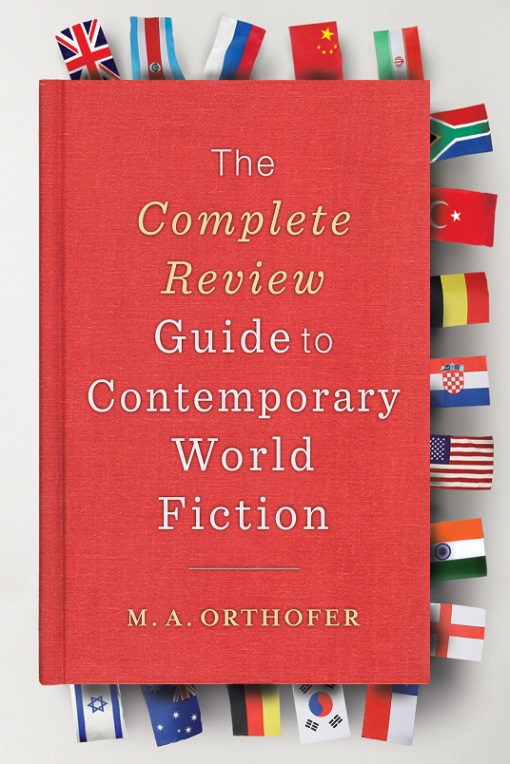
The CR Guide

The CR:the book
to e-mail us:

Books, Inq.
Bookninja
BookRiot
Critical Mass
Guardian Books
The Millions
MobyLives
NewPages Weblog
Omnivoracious
Page-Turner
PowellsBooks.Blog
Three Percent
Perlentaucher
Rép. des livres
Arts & Letters Daily
Bookdwarf
Buzzwords
The Millions
The Rumpus
Two Words
Waggish
See also: links page

opinionated commentary on literary matters - from the complete review
PEN World Voices Festival cancelled | RSL Ondaatje Prize shortlist
'Chronicles' | Nicholas Royle Q & A
PEN World Voices Festival cancelled
Things are not going well at PEN America: after cancelling their literary awards (see my recent mention), they have now also announced that they have cancelled this year's PEN World Voices Festival, which was to run 8 through 11 May in New York City (and 8 through 18 May in Los Angeles).
What next ?
(Posted by: M.A.Orthofer) - permanent link -
RSL Ondaatje Prize shortlist
The Royal Society of Literature has announced the shortlist for this year's RSL Ondaatje Prize, awarded: "for a distinguished work of fiction, non-fiction or poetry, evoking the spirit of a place" -- not yet at the official site, last I checked, but see for example the report in The Bookseller.
Six titles are left in the running, selected from 194 entries.
The winner will be announced on 14 May.
(Posted by: M.A.Orthofer) - permanent link -
'Chronicles'
Via I'm pointed to the announcement that The Ashoka Centre for Translation partners with Penguin Random House India to unveil ‘Chronicles’ (also at PRH India).
It's a new: "non-fiction translation series aimed at bringing creative-critical textual narratives from various Indian languages into English". That sounds promising, and is certainly welcome; the inaugural lineup shows a nice range in both languages and subjects.
Let's hope these titles also make it into markets beyond just India; I certainly would love to see them.
(Posted by: M.A.Orthofer) - permanent link -
Nicholas Royle Q & A
At Bookmunch Richard Clegg has “Not part of the mainstream” – an interview with Nicholas Royle, author of Shadow Lines.
He certainly collects a lot .....
Royle's White Spines and Shadow Lines (Salt publicity pages here and here) certainly sound like they're right up my alley; I look forward to checking them out at some point. (Meanwhile, two of his novels are under review at the complete review: First Novel and Antwerp.)
(Posted by: M.A.Orthofer) - permanent link -
EBRD Literature Prize finalists | Surrealism
EBRD Literature Prize finalists
The European Bank of Reconstruction and Development has announced the three finalists for its Literature Prize, "awarded to the year's best work of literary fiction translated into English, originally written in any language of the regions in which the Bank currently invests and published for the first time by a European (including UK) or North American publisher in the period in question".
The finalists are:The winner will be announced 13 June.
- Barcode, by Tóth Krisztina (tr. Peter Sherwood)
- The End, by Bartis Attila (tr. Judith Sollosy)
- The Wounded Age, by Ferit Edgü (tr. Aron Aji)
(Posted by: M.A.Orthofer) - permanent link -
Surrealism
At Art in America Ara H. Merjian offers a list of Eight Essential Books About Surrealism -- including André Breton's Nadja and Mark Polizzotti's recent Why Surrealism Matters.
I'd make a case for Gérard Durozoi's History of the Surrealist Movement, too .....
(Posted by: M.A.Orthofer) - permanent link -
Women's Prize for Fiction shortlist | Helen Vendler (1933-2024)
How Nietzsche Came in From the Cold review
Women's Prize for Fiction shortlist
They've announced the six-title-strong shortlist for this year's Women's Prize for Fiction, "awarded annually to the author of the best full-length novel of the year written in English and published in the UK".
I haven't seen any of these.
The winner will be announced 13 June.
(Posted by: M.A.Orthofer) - permanent link -
Helen Vendler (1933-2024)
Poetry critic and scholar Helen Vendler has passed away; see, for example, The New York Times' obituary (presumably paywalled).
(Posted by: M.A.Orthofer) - permanent link -
How Nietzsche Came in From the Cold review
The most recent addition to the complete review is my review of a Tale of a Redemption, as Philipp Felsch writes about How Nietzsche Came in From the Cold.
(Posted by: M.A.Orthofer) - permanent link -
Deutscher Sachbuchpreis shortlist | Cullman fellows | Sudhir Kakar (1938-2024)
Deutscher Sachbuchpreis shortlist
They've announced the shortlist for the German Non-Fiction Prize -- eight titles, selected from 225 (unfortunately not revealed) submissions.
The winner will be announced 11 June.
(Posted by: M.A.Orthofer) - permanent link -
Cullman fellows
The New York Public Library has announced the latest batch of fellows at the Dorothy and Lewis B. Cullman Center for Scholars and Writers who will now receive: "a stipend of up to $85,000, the use of an office with a computer, and full access to the Library’s physical and electronic resources" for the term of the fellowship, which runs September through May.
The fifteen fellows were selected from 620 applicants, from 66 countries. They include Traces of Enayat-author Iman Mersal and My Fathers' Ghost is Climbing in the Rain-author Patricio Pron.
(Posted by: M.A.Orthofer) - permanent link -
Sudhir Kakar (1938-2024)
Psychoanalyst and author Sudhir Kakar has passed away; see, for example, Rishika Singh's report in the Indian Express
Two of his books are under review at the complete review: The Ascetic of Desire and Ecstasy.
(Posted by: M.A.Orthofer) - permanent link -
PEN America Literary Awards | Merve Emre Q & A
The Answer to Lord Chandos review
PEN America Literary Awards
PEN America has announced the cancellation of its Literary Awards ceremony -- and, with 28 authors and translators of 61 nominated for the book awards having withdrawn their books from consideration, several of the prizes are going without winners being named.
With nine of the ten authors nominated for the PEN/Jean Stein Book Award withdrawing their work from consideration, "the Estate of Jean Stein has directed PEN America to donate the $75,000 award to the Palestine Children's Relief Fund"
One author who didn't have a chance to withdraw her name will get her prize: Maryse Condé is getting this year's PEN/Nabokov Award for Achievement in International Literature posthumously.
(Posted by: M.A.Orthofer) - permanent link -
Merve Emre Q & A
In the Hindustan Times Simar Bhasin has a Q & A with Merve Emre - "Things should be read in as many different ways as possible".
Among her responses:Any other contemporary writers who, in your opinion, deserve more literary attention ?(Two Iyer novels are under review at the complete review -- Spurious and Wittgenstein Jr. -- as are several works by Murnane, e.g. Barley Patch.)
I think the next Nobel Prize winner should be Gerald Murnane, who is an Australian novelist and is utterly, utterly brilliant. There is a fantastic English writer named Lars Iyer who is a genius, I think, and writes these fantastic academic satires. Brilliant. Very, very, very funny.
(Posted by: M.A.Orthofer) - permanent link -
The Answer to Lord Chandos review
The most recent addition to the complete review is my review of Pascal Quignard's The Answer to Lord Chandos, coming out from Wakefield Press.
This is Quignard's response to Hugo von Hofmannsthal's classic 'Lord Chandos Letter' -- see, for example, the recent Joel Rotenberg translation from New York Review Books. Quignard dates his letter to Chandos 23 April 1605 -- and today, 23 April, happens also to be Quignard's birthday !
(Posted by: M.A.Orthofer) - permanent link -
CWA Daggers longlists | The Novices of Lerna review
CWA Daggers longlists
The Crime Writers' Association has announced the longlists for their Daggers awards -- unfortunately not in one convenient list; annoyingly, you have to click on each category to see the longlisted titles. (The Bookseller has an (incomplete) overview.)
One of the titles longlisted for the Gold Dagger for best crime novel is under review at the complete review -- The Secret Hours, by Mick Herron.
Disappointingly, I haven't seen any of the titles longlisted for the Dagger for Crime Fiction in Translation.
The shortlists will be announced 10 May, and the winners on 4 July.
(Posted by: M.A.Orthofer) - permanent link -
The Novices of Lerna review
The most recent addition to the complete review is my review of a collection of stories by Ángel Bonomini, The Novices of Lerna, coming out from Transit Books.
(Posted by: M.A.Orthofer) - permanent link -
L.A. Times Book Prizes | The Sleepwalkers review
L.A. Times Book Prizes
They've announced the winners of this year's L.A. Times Book Prizes -- twelve categories, with Ed Park's Same Bed Different Dreams taking the fiction prize.
I not only have not reviewed any of the winning titles, I haven't seen a single one of the sixty (!) finalists. I am apparently really not keeping up with the latest titles .....
(Posted by: M.A.Orthofer) - permanent link -
The Sleepwalkers review
The most recent addition to the complete review is my review of the latest Scarlett Thomas, The Sleepwalkers.
(Posted by: M.A.Orthofer) - permanent link -
Daniel Dennett (1942-2024) | China's hottest genre ? | Salome in Dublin
Daniel Dennett (1942-2024)
Philosopher Daniel Dennett has passed away; see, for example, the obituary in The New York Times.
The only one of his books under review at the complete review is his Breaking the Spell.
(Posted by: M.A.Orthofer) - permanent link -
China's hottest genre ?
At Sixth Tone Zhou Min reports on How 'Farming Literature' Became China's Hottest Genre:This genre centers around a female protagonist’s efforts to get rich while battling various villains -- mainly in the guise of demanding relatives -- and has become widely popular with Chinese web novel readers and film and TV viewers,
(Posted by: M.A.Orthofer) - permanent link -
Salome in Dublin
The title of my novel Salome in Graz refers to a 1906 performance of the Richard Strauss opera, but if you want to get in the mood for reading it there's now another recent perfomance available for free viewing online: via I'm pointed to the recent Irish National Opera production that's now viewable at Operavision; you can watch it there through 19 October.
(Posted by: M.A.Orthofer) - permanent link -
New Asymptote
New Asymptote
The April issue of Asymptote is now up -- a ton of content, enough to keep you covered for the weekend.
And just a few days ago I mentioned that Faroese Literature was getting some good attention -- and there's a good dose of Literature from the Faroe Islands in this issue as well.
(Posted by: M.A.Orthofer) - permanent link -
Republic of Consciousness Prize | Griffin Poetry Prize shortlist
Les aérostats review
Republic of Consciousness Prize
They've announced the winner of this year's Republic of Consciousness Prize -- rewarding: "the best fiction by small presses [in the UK/Ireland] publishing 12 or fewer titles a year and are wholly independent of any other commercial financial entity" -- and it is Charco Press, for Of Cattle and Men, by Ana Paula Maia, translated by Zoë Perry; see, for example, the report at The Guardian.
(Posted by: M.A.Orthofer) - permanent link -
Griffin Poetry Prize shortlist
They've announced the shortlist for this year's Griffin Poetry Prize -- "the world's largest international prize for a single book of poetry written in, or translated into English" --, selected from 592 entries (including 49 translations, from 22 languages), with Don McKay getting the Lifetime Recognition Award.
(Posted by: M.A.Orthofer) - permanent link -
Les aérostats review
The most recent addition to the complete review is my review of Amélie Nothomb 2020 novel, Les aérostats -- the 28th work by Nothomb under review at the site.
I'm still a few behind -- but getting there .....
(Posted by: M.A.Orthofer) - permanent link -
Sami Rohr Prize | Walking books
Sami Rohr Prize
They've announced the winner of this year's (US$100,000) Sami Rohr Prize for Jewish Literature, which alternates from year to year in honoring a work of fiction and of non; this year was a non year, and the prize went to Palestine 1936, by Oren Kessler.
(Posted by: M.A.Orthofer) - permanent link -
Walking books
At Outside Peter Moore lists The 50 Best Hiking, Trekking, and Walking Books of All Time -- which I'd normally ignore, but ... props for the inclusion of The Journey to the West by Wu Cheng'en.
(Posted by: M.A.Orthofer) - permanent link -
Max Lawton profile | Deep Vellum profile | More Salome variations
Max Lawton profile
At Prospect Josiah Gogarty profiles The translator bringing Vladimir Sorokin to English readers -- Max Lawton, translator of Blue Lard, among (many) other works.
(Posted by: M.A.Orthofer) - permanent link -
Deep Vellum profile
At The Mercury Paola Martinez reports on how Deep Vellum expands literary and translation options in North Texas -- that being publisher Deep Vellum, quite a few of whose books are under review at the complete review.
Impressive to hear that: "Deep Vellum is now becoming international as they expand their administrative offices to New York and possibly London".
(Posted by: M.A.Orthofer) - permanent link -
More Salome variations
Many Salome-variations are covered in my new novel, Salome in Graz, but the focus is on the ones that appeared up to 1906 -- but there is some mention of a few of the ones that came after, including some cinematic adaptations (Ken Russell !). One that my protagonists didn't get to was screened at the Berlinale practically at the same time the book came out -- Atom Egoyan's Seven Veils, starring Amanda Seyfried; it premiered at the Toronto International Film Festival last year.
I haven't seen this yet, but hope to at some point; meanwhile, see some of the reviews, at:And of course you can get my at Salome in Graz at Amazon, or here (where the promotional code LULUBOOKS15 at checkout gets you 15% off through 19 April).
- Deadline
- Far Out
- The Globe and Mail
- The Hollywood Reporter
- Indie Wire
- Screen Daily
- Toronto Star
- The Wrap
(Posted by: M.A.Orthofer) - permanent link -
Mater 2-10 Q & A | Gabriel review
Mater 2-10 Q & A
Hwang Sok-yong's Mater 2-10 has been shortlisted for this year's International Booker Prize, and at Scroll.in Harshaneeyam has International Booker interview: How Sora Russell and Youngjae Bae translated ‘Mater 2-10’ from Korea
(Posted by: M.A.Orthofer) - permanent link -
Gabriel review
The most recent addition to the complete review is my review of George Sand's 1839 Gabriel.
I was a bit surprised that this hasn't gotten more attention recently, given it's subject matter -- issues of gender-identity -- but the literary quality is ... well, not great.
This is published in the very impressive MLA Texts and Translations-series -- well worth working one's way through.
(Posted by: M.A.Orthofer) - permanent link -
Faroese Literature | John Braine profile
Faroese Literature
In New York they're holding Faroe Islands Culture Days this week, including with the interesting-sounding Literature from the Faroe Islands event on 17 April.
This gives me opportunity to point to the impressive FarLit-site -- a Faroese Literature promotion site. The Nordics are very good with their literary support -- check out Norwegian Literature Abroad, the Icelandic Literature Center, and the Finnish Literature Exchange, for example -- but it's also a reminder of how many languages/countries can't (or can't be bothered) to offer something similar. (Translation-support isn't cheap but, relatively speaking, it isn't expensive either; I think a lot of languages/countries would do well to at least invest in information-sites, if not outright financial support.)
(A reminder: the Faroe Islands have little more than 50,000 inhabitants.)
Meanwhile, with convenient timing, The Dedalus Book of Faroese Literature is coming out shortly -- see their publicity page --: twenty-seven texts ! Dedalus has shown an impressive commitment to Faroese literature -- notably in publishing the works of William Heinesen (The Black Cauldron, etc.).
(Posted by: M.A.Orthofer) - permanent link -
John Braine profile
At Quilette Brad Strotten profiles John Braine, in Desire and Ambition.
I'm usually all for the book over the movie, but I have to admit seeing the Laurence Harvey/Simone Signoret Room at the Top before coming to the book, and it -- especially the conclusion -- making a big (and devastating) impression on me.
(Posted by: M.A.Orthofer) - permanent link -
Wolfgang-Koeppen-Preis | The Red Handler review
Wolfgang-Koeppen-Preis
They've announced the winner of this year's Wolfgang Koeppen Prize, a biennial author prize awarded to someone whose work is in the spirit of Koeppen's, and it is Danish author Madame Nielsen; Open Letter published Nielsen's The Endless Summer a few years ago -- see their publicity page -- but much more is available n German.
This prize has a solid list of winners, but it's of particular interest in how the winner is chosen: it's the previous winner who makes the selection -- in this case, 2022 winner Christian Kracht (The Dead, Imperium, etc.) chose Madame Nielsen.
(Posted by: M.A.Orthofer) - permanent link -
The Red Handler review
The most recent addition to the complete review is my review of Johan Harstad's The Red Handler -- the Collected Works of (fictional) author Frode Brandeggen, in an (extensively) annotated edition, just out in English, from Open Letter.
(Two other Harstad titles have also been translated into English and are under review at the complete review, but I wonder if anyone will pick up his (1104-page) Max, Mischa & the Tet Offensive; see, for example, the Gyldendal Agency information page.)
(Posted by: M.A.Orthofer) - permanent link -
AI and writers/translators | John McGlynn Q & A
Whiting Awards | Guggenheim Fellowships
AI and writers/translators
The Society of Authors: "ran a survey of its 12,500 members and other authors, and received 787 responses" regarding 'experiences of generative artificial intelligence (AI) systems', and they summarize the findings here.
Interesting to hear that: 37% of translators, 20% of fiction writers, and 25% of non-fiction writers "said they had used generative AI in their work".
Also: 36% of translators say they have already lost work due to generative AI, while 43% say the income from their work has decreased in value because of generative AI.
And 8% of translators said they have used generative AI in their work because their publisher or commissioning organisation asked them to (!).
Yes, it seems pretty clear that the future is AI -- coming/taking over even more quickly than expected.
(Posted by: M.A.Orthofer) - permanent link -
John McGlynn Q & A
At the Asymptote blog Sarah Gear has Translating Indonesia's On-the-Ground Realities: An Interview with John McGlynn of the Lontar Foundation.
Lontar have published a fantastic selection of books; several are under review at the complete review.
(Posted by: M.A.Orthofer) - permanent link -
Whiting Awards
The Whiting Foundation has announced its ten 2024 creative writing fellows -- four in fiction, three in poetry, two in drama, and one in non-fiction; they each receive US$50,000.
(Posted by: M.A.Orthofer) - permanent link -
Guggenheim Fellowships
The John Simon Guggenheim Memorial Foundation has announced this year's batch of fellowships -- 188, selected from almost 3,000 applicants; see all the fellows listed here, for now, by subject (though, alas, not yet with information about the projects they were awarded the fellowships for ...).
The only fellow with any works under review at the complete review appears to be James Wood (The Book Against God).
Fiction fellows include Emma Cline, Laird Hunt, Julia Phillips, and Emma Straub; non-fiction fellows include Jonathan Alter and Adam Shatz. The only translation fellow is Ryan Bloom.
(Posted by: M.A.Orthofer) - permanent link -
Most challenged books in the US, 2023 | Lauren Oyler Q & A
The Homeless review
Most challenged books in the US, 2023
The American Library Association has announced the ten most challenged books in the US in 2023.
They're all: 'claimed to be sexually explicit', along with a variety of other issues .....
(Posted by: M.A.Orthofer) - permanent link -
Lauren Oyler Q & A
At Interview Steven Phillips-Horst has a Q & A with Lauren Oyler Wishes You'd Fact-Check Your Reviews.
Fact-checking always seems like a good idea, with reviews and most everything else -- but in fact Oyler also says that, while she fact-checks: "Some critics do not care so much about that, and that's perfectly fine". (It's not.)
(Posted by: M.A.Orthofer) - permanent link -
The Homeless review
The most recent addition to the complete review is my review of Stefan Żeromski's 1900 novel, The Homeless, just out in English, from Paul Dry Books.
Żeromski was nominated for the Nobel Prize in Literature four years running before his death.
(Posted by: M.A.Orthofer) - permanent link -
International Booker Prize shortlist | PEN America Literary Awards longlists
Carol Shields Prize shortlist
International Booker Prize shortlist
They've announced the six-title-strong shortlist for this year's International Booker Prize.
None of these are under review at the complete review, though I have two of them (the two published by Scribe).
The winner will be announced 21 May.
(Posted by: M.A.Orthofer) - permanent link -
PEN America Literary Awards longlists
PEN America has announced the longlists for their Literary Awards.
The only titles under review at the complete review are PEN/Jean Stein Book Award-longlisted title Biography of X, by Catherine Lacey, and PEN Translation Prize-longlisted The Premonition, by Banana Yoshimoto.
The small print at the bottom of the announcement notes: "These longlists have been amended and updated at the request of individual authors", as there has been considerable criticism of PEN America for their stance (or lack of one) regarding what is happening in Gaza and so, for example, Eugenia Leigh has withdrawn her originally longlisted book from consideration for the PEN/Voelcker Award for Poetry. See also, for example, the Sublunary Editions Statement on the 2024 PEN America Awards or Esther Allen declining the PEN/Ralph Manheim Award for Translation. (As longtime readers know, while I think it's perfectly fine for authors (or translators) to decline a prize -- à la Sartre or, as here, Allen -- I do not think prizes should take authors' (etc.) wishes into consideration when deciding on whether to long- or shortlist a book, or in awarding the prize (the author (etc.) can always decline it if they win), they should only concern themselves with the book(s). The book -- the text -- is all that counts.)
The winners will be announced 29 April.
(Updated - 11 April): See now also the statement from the Translation Prize judges.
(Posted by: M.A.Orthofer) - permanent link -
Carol Shields Prize shortlist
They've announced the shortlist for this year's Carol Shields Prize for Fiction -- celebrating: "creativity and excellence in fiction by women and non-binary writers in Canada and the United States", and notable not only for its US$150,000 top prize but for also for awarding the four other shortlisted losers $12,500 each, making it one of the most remunerative runner-up prizes going.
I haven't seen any of these.
The winner will be announced 13 May.
(Posted by: M.A.Orthofer) - permanent link -
RSL Ondaatje Prize longlist | Jean Genet's Héliogabale
RSL Ondaatje Prize longlist
The Royal Society of Literature has announced the longlist for this year's RSL Ondaatje Prize, awarded: "for a distinguished work of fiction, non-fiction or poetry, evoking the spirit of a place" -- fourteen titles; see, for example, Olivia Emily's report in ... Country & Town House.
(Posted by: M.A.Orthofer) - permanent link -
Jean Genet's Héliogabale
Yet another newly-found work by a deceased author -- Gallimard has published a four-act play by Jean Genet, Héliogabale; see their publicity page and the report at franceinfo.
I hope to see this -- I'm always curious about Heliogabalus-stories. Antonin Artaud famously wrote one -- Heliogabalus or, the Crowned Anarchist; see, for example, the Infinity Land Press publicity page -- and Louis Couperus wrote a Heliogabalus-novel as well, De berg van licht. The only Heliogabalus-title under review at the complete review at this time, however, is Martijn Icks' The Crimes of Elagabalus. (I had a look at Harry Sidebottom's The Mad Emperor -- see the Oneworld publicity pae -- but didn't take to it.)
(Posted by: M.A.Orthofer) - permanent link -
OCM Bocas Prize finalists | Salomé in Metz | Cut Guavas review
OCM Bocas Prize finalists
They've announced the three category winners -- in fiction, non, and poetry -- for this year's OCM Bocas Prize for Caribbean Literature, which will now compete for the final prize -- which will be announced 27 April.
(Posted by: M.A.Orthofer) - permanent link -
Salomé in Metz
The title of my new novel, Salome in Graz, refers to a 1906 performance of the Richard Strauss opera -- though there's a whole lot more to it -- and if you're reading it, or tempted to, you might want to check out other performances of the opera, such as the one at the Opéra Théâtre de Metz, which premiered on Saturday
This one is interesting because it's a rare production of Strauss' French version of the opera -- as, yes, with the help of Nobel laureate Romain Rolland, he adapted Wilde's original French text (remember, Wilde wrote the play the opera is (closely) based on in French). It was performed a few times back in the day, but Strauss pretty much gave up on it -- buoyed, no doubt, by the incredible success the German version was having -- and it was more or less out of circulation for ages. Even in France, the German version is much more frequently performed -- so also the Paris Opera production that you can catch next month.
Salome in Graz is very much about translation (and textual fidelity), so Strauss' French version -- and the English (and German and other) versions of Wilde's play -- play a significant role in the novel.
Back to the Metz production: see the bande-annonce for the production, or José Pons' (French) review at Ôlyrix (where he finds, regarding the two versions that: "la version originale déploie des ressorts plus puissants que la version française qui tend à temporiser un peu les événements et à en réduire leur éclat").
(Posted by: M.A.Orthofer) - permanent link -
Cut Guavas review
The most recent addition to the complete review is my review of A novel shapeshifting as a screenplay by Robert Antoni, Cut Guavas or ... Postscript to the Civilization of the Simians.
(This was shortlisted for the 2019 OCM Bocas Prize.)
(Posted by: M.A.Orthofer) - permanent link -
Bhadariya Library | Cloud Atlas at 20 | The Villain's Dance review
Bhadariya Library
In the Deccan Herald V.Raghunathan writes about A literary oasis in the desert -- the Bhadariya Library, which I was unfamiliar with.
No pictures with that article, but see, for example, Priti David on Jaisalmer's underground library -- and, wow.
Bizarre/amazing.
(Posted by: M.A.Orthofer) - permanent link -
Cloud Atlas at 20
Stephen King's Carrie is fifty -- see, for example, Neil McRobert in Esquire on Why Carrie Is Still Scary as Shit -- and David Mitchell's Cloud Atlas is twenty, with Gabrielle Zevin explaining in The Guardian Cloud Atlas at 20: What makes a novel tattoo-worthy ?
I like the opening observation:A literary agent once told me that when a fledgling writer compares their novel to David Mitchell’s, he invariably knows it will be awful. Once you have written a book like Cloud Atlas, you have not written Cloud Atlas because Cloud Atlas is not like anything.
(Posted by: M.A.Orthofer) - permanent link -
The Villain's Dance review
The most recent addition to the complete review is my review of Fiston Mwanza Mujila's The Villain's Dance, just out in English, from Deep Vellum.
(Posted by: M.A.Orthofer) - permanent link -
go to archive
- return to top of the page -
© 2024 the complete review

Main | the New | the Best | the Rest | Review Index | Links